Want to Summon Less Animal Suffering?
I've been thinking about Julia Galef's chart of how much of an animal's live an unit of food costs. Her summary of her approach:
If you’re bothered by the idea of killing animals for food, then going vegetarian might seem like an obvious response. But if you want your diet to kill as few animals as possible, then eschewing meat is actually quite an indirect, and sometimes even counterproductive, strategy. The question you should be asking yourself about any given food is not, “Is this food animal flesh?” The question you should be asking yourself is, “How many animal lives did this food cost?”
She ends up with this chart:
 But as we know, from a hedonic utilitarian perspective, the moral cost of consuming animals is not measured in their deaths, but the net suffering in their lives - and lives are made of days.
I am not a hedonic utilitarian, but I think that for big-picture issues, utilitarianism is an important heuristic for figuring out what the right answer is, since at least it handles addition and multiplication better than our unaided moral intuitions.
So I looked up how long each of these animals typically lives, to estimate how many days of each animal's life you are responsible for when you consume 1,000 calories of that animal. The Food and Agriculture Organization of the United Nations says that beef cattle are slaughtered at 36 months old (i.e. 1,096 days), and pork hogs at 6 months old (183 days). Wikipedia says that chickens raised for meat typically live about 6 weeks (42 days), and laying hens about 2 years (730 days), and that dairy cows live an average of four years (1,461 days) before dying or being culled and sold as beef.
Using those figures yields the following:
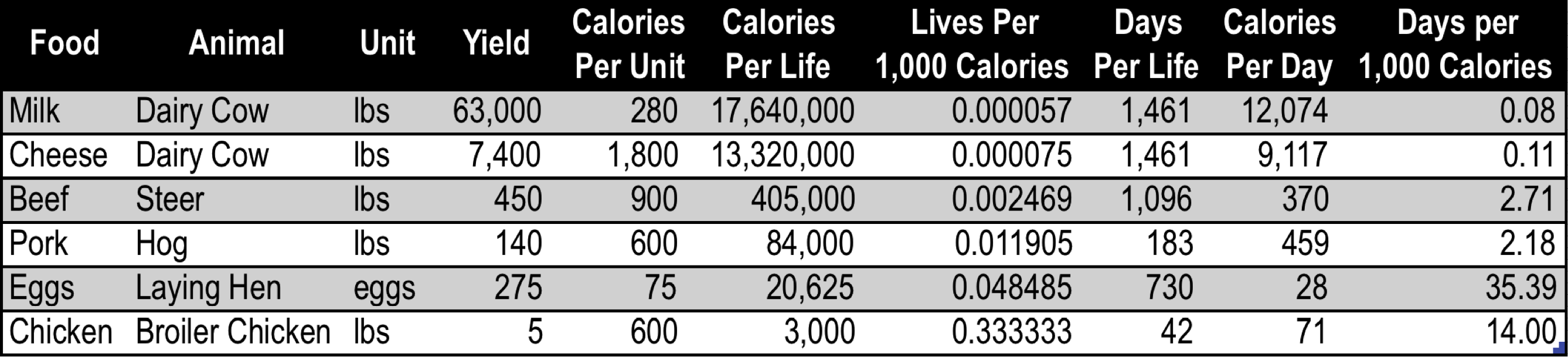
Eggs now appear to be even worse than eating chicken flesh, since broiler chickens live very short lives compared to laying hens. Similarly, beef loses its advantage relative to pork, which comes from smaller but faster-maturing animals. Dairy still seems pretty okay, comparatively.
A few complicating factors need to be explored before this becomes a reliable guide, though.
First, not all animal suffering is of equal intensity. It may actually be net good for well-treated animals to exist. It is still not obvious that factory farmed animals would rather never have been born, or how to count their suffering.
Second, it is not obvious how to attribute responsibility for animals that are not themselves raised to feed humans. For example, Julia divided laying hens' yield in half to account for killed male chicks, but the chicks obviously live almost no time. If you double the yield back to what it would have been before this adjustment, eggs come out about the same as chicken. Similarly, if a dairy cow is killed for beef, it seems like this should lower milk drinkers' and cheese eaters' day counts, since beef eaters contribute to the viability of raising dairy cattle too.
Finally, there may be different elasticity for different animal products; because lowered demand leads to lowered prices, which increase demand, the industry might reduce production by less than a full chicken for each chicken you abstain from buying, and this rate may differ by animal.
What am I going to do? I like eggs a lot, and think they're cheap and pretty good for me, and I basically believe Katja Grace's argument that I shouldn't put in a lot of work to change my behavior on this, so I'm going to keep eating them, though I'll continue to preferentially buy free range eggs where available. I have a rationalization that laying hens don't suffer nearly as much as broilers, so I'll flinch a little bit each time I consider eating chicken. I was favoring eating beef over pork due to Julia's analysis, but I will stop doing that now that I know the two are pretty much equivalent in terms of animal-days.
[UPDATE: Brian Tomasik has an unsurprisingly somewhat more thoroughly worked out treatment of this line of thinking here.]
13 Comments
I often feel that posts and directions like these justify the existentialist distrust of rationalism. There is an impulse to build and use metrics for lives, for days, for sentience, and explore the phase space these dimensions imply as though it will contain an answer.
The search seems worthwhile and it's good to post the steps along the way for social reinforcement, but all the answers feel partial to me in a potentially dogmatic sort of way.
xposted to facebook.
Re: "I was favoring eating beef over pork due to Julia’s analysis, but I will stop doing that now that I know the two are pretty much equivalent in terms of animal-days."
Beef cows probably have the best lives of any farm animal. The first half of their lives is typically spent on pasture, so -- except for possible unanesthetized dehorning, branding, and castration :( -- you could potentially omit half of their days.
Unfortunately, beef is also worst in terms of climate change. Dairy is less bad in that regard. Besides milk/cheese you can get whey protein powders. Holden gives advice on whey smoothies here.
I've updated back towards flinching a bit from pork products relative to beef, though I'm not going to put up a new version of my table unless I take the time to look at this sort of thing systematically. I should probably add a link to yours, though.
1) Consider using the doubled egg production figure in your chart since that fits much more clearly with your methodology; as it reads now either the "yield" or the "days per life" figure seem misleading.
2) Consider removing the concern about elasticities; my prior is that consuming one less unit [egg, cow, car etc.] causes about 1 less to be produced in the long term. Neoclassical economic theory would suggest that in the long term, the industry will size itself to keep same equilibrium price, even if that means producing 2x or 0.5x what it produces now. The exception would be if there are reasons to expect major changes to input costs such as gains to scale, a finite supply of inputs, or interactions with government subsidies. Naively, none of these effects are predictable/large/directed enough to adjust the prior in these cases.
On elasticity, my understanding is that (surprisingly) it's material in this case. Peter Hurford cites these figures:
By my reasoning, all that matters is, how much does it cost to produce widgets (when producers aren't shocked by anything)? That's my estimate for the (arbitrarily long run) equilibrium price. Then, how many widgets are people willing to buy at that price (when consumers aren't shocked by anything)? That's my estimate for the (arbitrarily long run) equilibrium quantity. If 1 person decides to permanently consume 1 widget less at that price (imagine the person announcing their consumption change 10 years in advance), then my best guess at the new equilibrium quantity is one less than it was before (which seems to match pre-economic intuition).
My argument is less that neoclassical economics is perfect (haha), more that short term elasticities are a red herring. By my reading, all the discussion of short term elasticities by Peter, Compassion, and ACE is introducing unnecessary complexity and opportunity for measurement error, undermining the quality of the estimates.
It'd be virtuous too - feral hogs are an invasive species..
Using "days per life" for comparison gives all the weight to suffering per day. That assumes that the suffering from the animal's death is much smaller than the suffering it has by virtue of being on a farm. However, the blog post doesn't try to justify that assumption.